小而聪明:芬兰和卢森堡这两个“超级大国”
芬兰总统亚历山大·斯图布在访问卢森堡期间谈到了地缘政治、科技以及如何发挥“小”国家的细分优势。四个项目展示了这一过程的实际表现。
12/10/2026
本文由英文原文自动翻译而成,翻译过程中可能存在一些错误,敬请谅解。
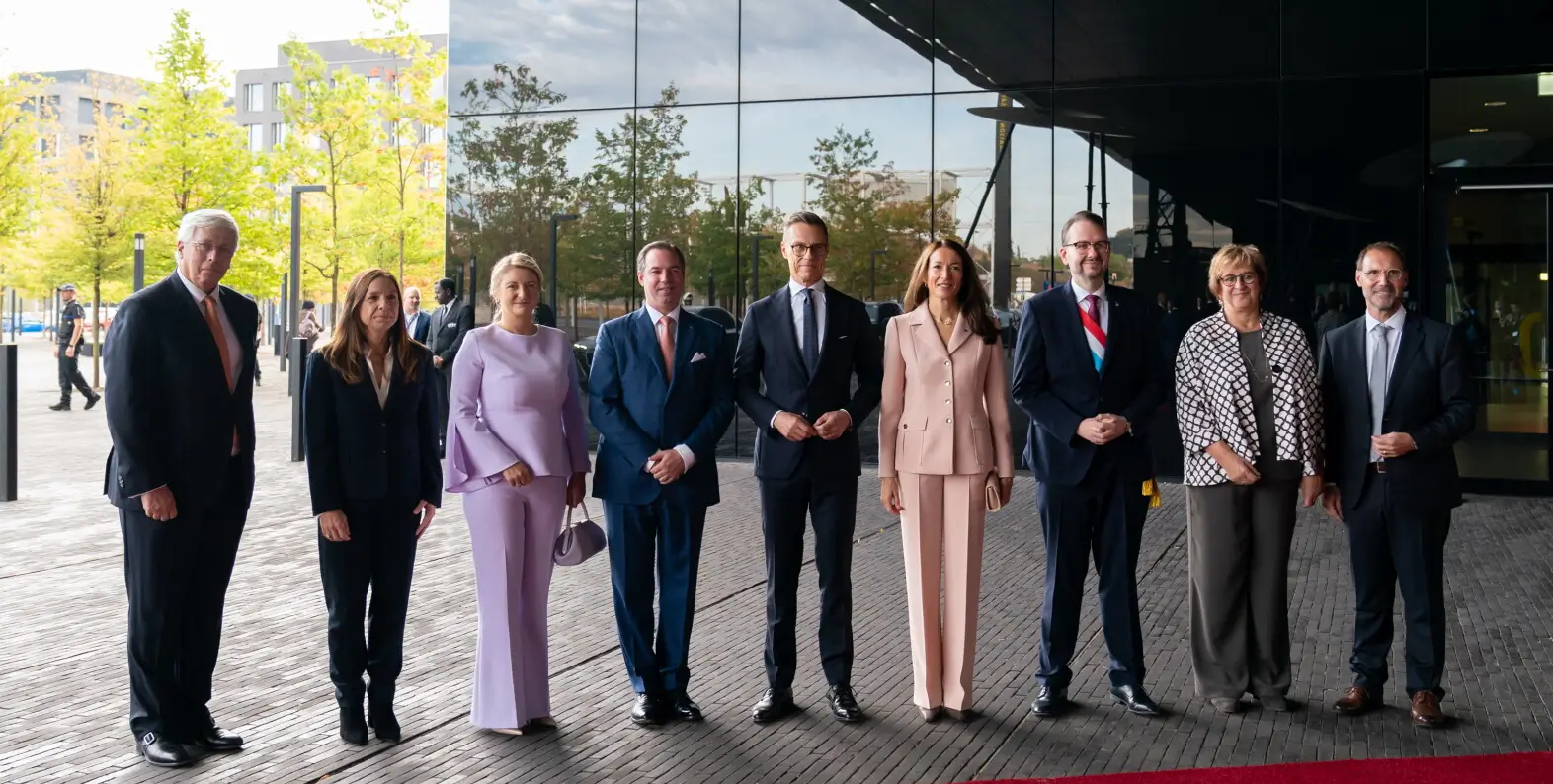
At the invitation of Their Royal Highnesses the Grand Duke and Grand Duchess, Alexander Stubb, President of the Republic of Finland, and First Lady Suzanne Innes-Stubb made an official state visit to Luxembourg on 29 and 30 September 2026.
A world shaped by geopolitics and technology
 In his keynote, “Values, interests and power in the age of strategic competition”, President Stubb described a world order shaped by two main drivers: geopolitics and a fast-moving technological revolution. Geopolitical competition, he said, is weakening international rules and institutions and giving rise to more ad hoc coalitions and transactions. At the same time, advances in artificial intelligence (AI), biotechnology and robotics bring both opportunities and risks.
Climate change is a third driver, linked to the first two as it can contribute to geopolitical conflict, while technology can help address it. President Stubb explored these drivers through the lenses of values, interests and power, and referenced similarities between Luxembourg and Finland.
“We have values which we share: democracy, freedom, justice, equality, human rights, fundamental rights, rule of law, international institutions, and we have [shared] interests,” said President Stubb. “Sometimes they vary, but often they start from basic security, then they move on to welfare and society. But what we lack is power in comparison to, say, bigger players like the United States and China, and the way in which we have power is by having influence, and the way in which we get influence is by having information which we can share, and I think both of us very much punch above our weight.”
During the visit, Luxinnovation coordinated a research and innovation session that exemplifies collaboration.
 Four projects addressing societal challenges were presented:
- EAGLE-1 (SES): A European-led, space-based quantum key distribution system with ground networks, enabling secure key distribution across the European Union and beyond. Finland participates in the NordicQCI initiative, whose optical ground station connects to EAGLE-1;
- IrriWatch (Hydrosat): An AI-powered platform combining thermal satellite imagery and agronomic analytics to monitor crop water use and irrigation performance. It is already deployed in more than 70 countries;
- Clinical Data Foundry (Luxembourg Institute of Health): Secure, standardised collection, analysis and sharing of healthcare data through federated data spaces and quantum-safe technologies, while protecting patient privacy. Potential cooperation with Finnish partners is under discussion;
- European genomic data infrastructure (LETZDATA – Luxembourg Data Factory and Luxembourg National Data Service, LNDS): A collaboration with Findata, the Finnish Social and Health Data Permit Authority. Building on the September 2025 Memorandum of Understanding, it uses European health data spaces and digital genome infrastructures to support healthcare innovation and precision health.
“Four strong projects. Four dedicated teams. One clear conviction: that small, focused countries can lead on the technologies that matter most,” pointed out Mario Grotz, CEO of Luxinnovation.
Cooperation over competition
AI is not value-neutral, particularly when combined with biotechnology. It raises fundamental questions about how the technology should be developed and governed. In a competitive world, President Stubb asked: “Do you want to cooperate, or do you want to drive that competition into conflict?” He argued that cooperation can contain competition, with Finland and Luxembourg among the countries that uphold international institutions, rules and norms.
President Stubb and Norway’s Prime Minister, Jonas Gahr Støre, had recently put forward a declaration at the United Nations on containing AI at three levels: between companies, within and between governments, and globally through the UN. Luxembourg, President Stubb said, supported the initiative immediately. So far, around 30 other countries and the European Commission have signed up to this call, including Canada, Singapore, France, Germany and the United Arab Emirates.
"If you have a part in the technology, then you can also have a say in the regulation." — Alexander Stubb, President of the Republic of Finland
He outlined three possible approaches to AI: competing without limits, cooperating, or slowing it down. He favours cooperation, considering a slowdown unrealistic. President Stubb stated: “I am very optimistic that we as human beings will have the cognitive capacity to take a decision which will put things back on track.”
 Jens Kreisel, Rector of the University of Luxembourg, made a related point in his welcome address: “No university, no country, and no discipline can tackle the great challenges of our time alone. […] human judgment, trust, and collaboration become more important, not less.”
Separately, Sanna Alaranta, Senior Advisor for European R&D and Innovation Support at Luxinnovation, shared preliminary Horizon Europe figures. Finland has received nearly €1.5 billion from the programme and Luxembourg €316 million to date. Both countries receive most of their funding in the Digital, Industry and Space area. Finland’s second area is Food, Agriculture and Natural Resources, while Luxembourg’s is Climate, Energy and Mobility.
Luxembourg and Finland have 286 collaborations in Horizon Europe, and Finland is Luxembourg’s 15th collaboration partner country. Ms Alaranta highlighted three projects:
- ACUMEN developed an AI-aided digital twin for multimodal traffic management. Aalto University coordinated it. Luxembourg partners included LuxMobility and S.L.A., alongside the Luxembourg Institute of Science and Technology and the University of Luxembourg.
- AMAZING-6G tests 14 use cases for 6G in healthcare, public safety, energy and transport. Luxembourg’s OQ Technology works with Finland’s VTT, the Finnish Meteorological Institute and Aurora Powertrains.
- CitComTeF, under the Digital Europe Programme, is a testing and experimentation facility for AI in smart cities and communities.
“As President Stubb underlined, we could do better and have more Luxembourg-Finland collaborations, as we have a lot of similarities in terms of values and goals,” said Ms Alaranta.
A stake in the technology stack
President Stubb described three security interests that every country faces in the age of AI: national, economic and societal security.
National security covers defence and cyber resilience, including cyber-attacks that AI can now generate with or without human intervention. Economic security requires a few choke points: technologies or resources that other countries depend on in the “AI stack”, the chain of layers behind AI, from energy and critical minerals to chips, computing power and applications.
No single country or company will control the entire stack, so having a position in it gives a country a voice. “This is kind of good news for smaller countries like Finland and Luxembourg because we have the capacity to be in that race,” President Stubb said. “If you have a part in the technology, then you can also have a say in the regulation.”
Societal security, he said, is the interest most often forgotten. As AI changes the economy and work, societies need to stay resilient. The test, he said, is whether the transition to an AI economy can protect human worth and dignity.
"Small, focused countries can lead on the technologies that matter most."
— Mario Grotz, CEO of Luxinnovation
President Stubb noted that military capacity now depends much more on technology than on troop numbers. He sees two routes for small countries such as Luxembourg and Finland: geopolitical power through the European Union and technology power through a few niche technologies of their own. Space and quantum are also strengths the two countries share. He described Luxembourg and Finland as “small but smart” countries: combined with smartness, he said, small size brings influence.
President Stubb closed by explaining that strategic dependency should be viewed through three lenses. The first is what a country depends on from others. The second, which he considers more important, is what others depend on from a country. Finland’s examples include icebreakers, telecommunications networks, satellites, quantum technology and the largest nickel and cobalt reserves in Europe. The third is diversification, so that no country becomes overly dependent on any single partner.