Dépoussière. Allumez.
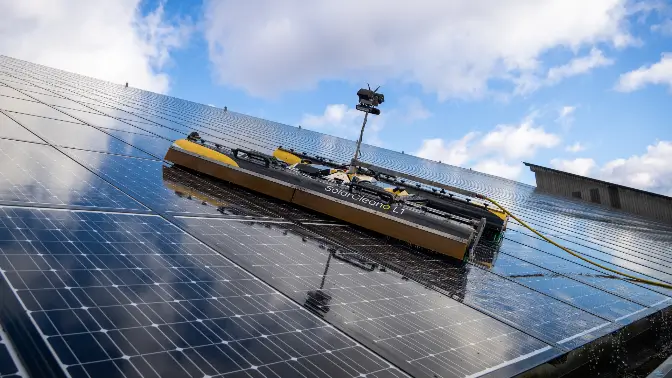
Comment nettoyer un parc de panneaux solaires de la taille de 30 terrains de football ? SolarCleano, une entreprise fondée au Luxembourg il y a 10 ans, développe des robots spécifiquement pour maintenir les parcs photovoltaïques (PV) de taille industrielle propres.
 Zuza Reda-Jakima
29/10/2026
It’s not that much about aesthetics, as it is about efficiency. “A solar panel covered in dust can lose as much as 30% of its output, a huge production impact when you’re operating at industry scale,” explains SolarCleano’s CEO Christophe Timmermans. “The more the electricity costs rise, the more important it becomes to consider the return on investment into PV plants, and so the cleaning needs to be better and better.”
He came up with the idea to produce autonomous solar panel-cleaning robots after a sister company, Fallprotec, which produces height safety equipment, heard a client bemoan the tediousness of manually cleaning solar panels. “With the engineers we could rely on at Fallprotec, and our technical background, we sat down at the drawing board and created a cleaning robot prototype that we took to the solar industry expo in Munich in 2017.”
The response was such that the prototype very soon moved to the production line. Almost a decade later, SolarCleano has sold over 1,000 units in more than 100 countries.
The secret to the company’s success is the relentless pursuit of improvement. “Our key selling point is the technology,” says Mr Timmermans. “Our research and development team must deliver one new robot per year.”
Ideas come from unexpected places. One of the company’s latest robots was inspired by agricultural machinery used in vineyards. “We saw these tractors… and thought we could replace the vines with panels,” he says. The concept was adapted, engineered and transformed into a new cleaning solution – illustrating how cross-industry thinking feeds innovation.
Standing out
Despite Luxembourg being a small country with costly labour, Mr Timmermans believes that being based here has contributed to the company’s success. “As we rely on top-class engineering that ensures excellent technologies and reliability of our products, we can promise decreased service costs for customers. This allows us to be competitive against similar solutions from typically less pricy Chinese or Indian manufacturers,” he explains.
What also helps is public support for R&D, both through direct investments and tax advantages, a significant factor in SolarCleano's rapid international growth. But soft factors also play an important role when entering new markets. “It’s quite exceptional to have the country’s ambassador travel with you and pitch your business to local stakeholders,” he said.
This was the case when SolarCleano decided to target China, the world’s leader in solar energy production. The support of Luxembourg’s local representatives in setting up meetings with the right people helped SolarCleano to recently secure a contract to deliver robots for a large-scale solar park in a desert region of Xinjiang, in the western part of the country.
Bigger, wider, faster
Given the solar industry’s rapid development, the company now produces a wide range of robots – from small ones weighing less than 50 kilos, which can be carried by a person, to giants measuring up to 14 metres wide – to cater to different geographies and project sizes. “We produce roughly one small robot per day,” Mr Timmermans says.
The company has built its success on a simple but demanding principle: continuous research and development. “The industry transforms itself at such a speed that you simply cannot rely on a model that you developed 12 months ago – to stay in the game, you need to innovate constantly,” he says. As in other industries, AI is playing a huge role too.
“You could say AI itself is becoming one of the biggest clients given its energy consumption,” argues Mr Timmermans. The computing power required to run advanced AI models demands enormous data centres and, with them, a continuous, stable energy supply.
He expects the most dramatic growth in the PV industry to come from the world’s vast arid regions, such as Australia, India, China, the Middle East, North Africa and Chile. These are the biggest deserts, where land is often effectively free as it cannot be farmed or developed otherwise. “The perfect place to host utility-scale solar farms and produce energy at very low cost.”
In parallel, AI helps SolarCleano add value and go beyond ‘just cleaning’. “We are incorporating cameras on top of our robots and generating insights for clients, for instance by telling them which panels have to be replaced,” says Mr Timmermans. In large-scale solar farms, where installations can include millions of panels, this capability is critical.
The next frontier
When he started the company, a 1-gigawatt solar park was considered gigantic; nowadays, SolarCleano services projects roughly 20 times larger. “Obviously, our robots had to evolve. One that cleans 2,000 panels per day is not enough for a power plant that has 3 million panels,” he explains.
Bringing ideas to life requires a structured yet flexible organisation. SolarCleano’s R&D activities are divided into three core areas: mechanical engineering, automation and artificial intelligence. Mechatronics teams design and build the machines, automation engineers develop the systems that enable them to operate autonomously, and AI specialists develop data-driven capabilities.
R&D equals constant testing, and many ideas that look good on paper fail in production or deployment. “We make a lot of mistakes, and a lot of R&D money is thrown out the window, but that’s part of the game. You must get used to failing multiple times until you find the next break that will take you to the next level,” he admits. “For us, innovation is not about improving existing products, but about anticipating future needs.”
Photo credit and copyright: SolarCleano
This article was originally published in Crossroads Magazine no. 9. Read the full edition below: