How Poseidon Energy found its European base
Building energy systems for critical infrastructure requires the right partners, financing and a stable location. For Poseidon Energy, that base is Luxembourg.
13/10/2026
For more than two decades, Belgian entrepreneur Bjorn Van Haver has worked towards one goal: producing sustainable energy around the clock, independently of the grid. Today, his company Poseidon Energy, a Luxembourg energy technology scaleup, develops sovereign power systems for critical infrastructure, from AI datacentres to defence facilities.
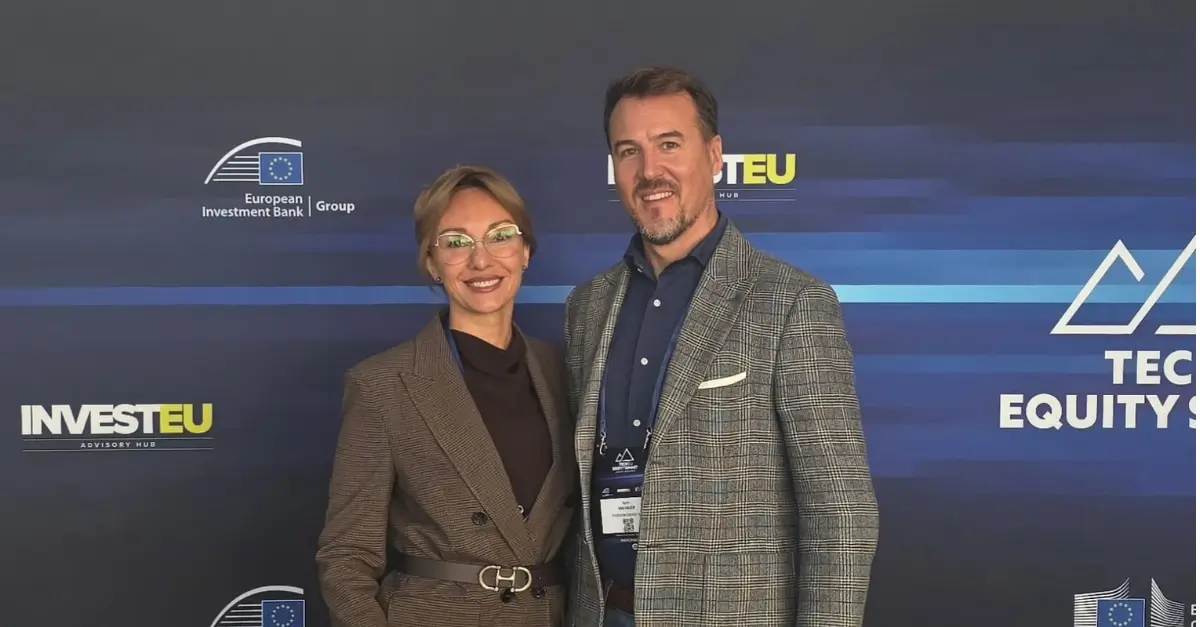
But technology alone is not enough to succeed. Bjorn, who serves as Poseidon Energy’s CEO, and co-founder and COO Olga Miglane, needed a stable European base, access to the right expertise and an ecosystem where conversations could lead to practical opportunities. A place where the business could scale.
Building sovereign energy infrastructure for defence and AI workloads
Poseidon Energy is developing its technology at a time when demand for reliable energy is rising. AI, datacentres and defence operations all depend on stable power, while many organisations are looking for ways to reduce their environmental impact.
Running on biomethane with CO2 capture, the process also removes more CO2 than it emits.
Bjorn Van Haver, Poseidon Energy
In 2008, Bjorn started commercialising a technology that produces electricity continuously. It uses electrochemical devices called solid oxide fuel cells (SOFC), which convert fuel directly into electricity without combustion in a highly efficient way. It builds on more than three decades of development and over 200 million combined running hours. A stack runs more than 40,000 hours on average, with records beyond 50,000 hours. “Running on biomethane with CO2 capture, the process also removes more CO2 than it emits,” Bjorn explains.
Another advantage is that the power infrastructure is sovereign. “Sovereign power means more than backup. Each site owns its power plant, operated by a European party. It runs 24/7 as primary supply, connected to the grid or fully independent, with 99.995% availability,” Bjorn points out. Its modular 500 kW skids add battery storage in a redundant highly secured so-called Tier IV design, with software for grid balancing.
The right location for attracting investors
With work already underway, Olga and Bjorn set out to find the right location for Poseidon Energy. “We wanted more than a registered address – we wanted to build the company in an environment where technology, finance and cross-border business genuinely come together,” Olga underlines.
The company’s portfolio includes a power and land project of up to 500 MW for what is planned as the world’s first carbon-negative hyperscale AI datacentre campus in Belgium, an underground datacentre campus of up to 60 MW in Italy and a pilot at a Belgian defence site. Such large-scale projects require substantial investment. Being in a place that would inspire investor trust was therefore a priority.
We wanted to build the company in an environment where technology, finance and cross-border business genuinely come together.
Olga Miglane, Poseidon Energy
“When comparing locations, we realised that being Luxembourg-based signalled confidence to large investors,” says Bjorn. “The country is safe and provides legal and financial stability. That is what we need as we move into growth.” The next step is European manufacturing of power systems, with a target capacity of 500 MW by 2030.
Joining Luxembourg’s innovation community
Investor confidence was one part of the decision. The founders also wanted to become part of a business community that could help them develop the company. The two co-founders reached out to a local fiduciary firm, which supported them with incorporating the company in late 2025. Around the same time, Luxinnovation, Luxembourg’s national innovation agency, invited them to connect with the local business and innovation community.
The ecosystem here is highly connected – one good conversation often leads naturally to the next. For a young company like us, that makes a real difference.
Olga Miglane, Poseidon Energy
For Olga, the value of the ecosystem lies in how easily these contacts connect. “The ecosystem here is highly connected – one good conversation often leads naturally to the next,” she says. “For a young company like us, that makes a real difference.” The Luxinnovation team introduced Poseidon Energy to the Ministry of the Economy and to tech incubator Technoport, where the startup found both suitable offices and further assistance. BNP Paribas became a banking partner.
The ecosystem also provided useful contacts for R&D. An application to the Ministry of the Economy for funding for a three-year R&D project is underway, supported by Luxinnovation. Poseidon Energy already had technology and business partners across Europe and in South Korea, but the team has now met with researchers from the Luxembourg Institute of Science and Technology (LIST) and the University of Luxembourg that might be valuable partners in the future.
Scaling from four to 100: investment and next steps
Poseidon Energy's next phase is about turning its foundations into a fully operating business. “We are looking for a private equity partner with skills in growing companies who can follow us from the start to a later stage,” says Bjorn. The objective is also to grow the current team of four to 25 people by the end of 2027 and close to 100 by 2030.
For Olga, the company’s next phase will also determine whether Luxembourg becomes the long-term home they were looking for. “The more time we spend here, the more I feel that this can become a real home for our company.”
Photo credits: Poseidon Energy