
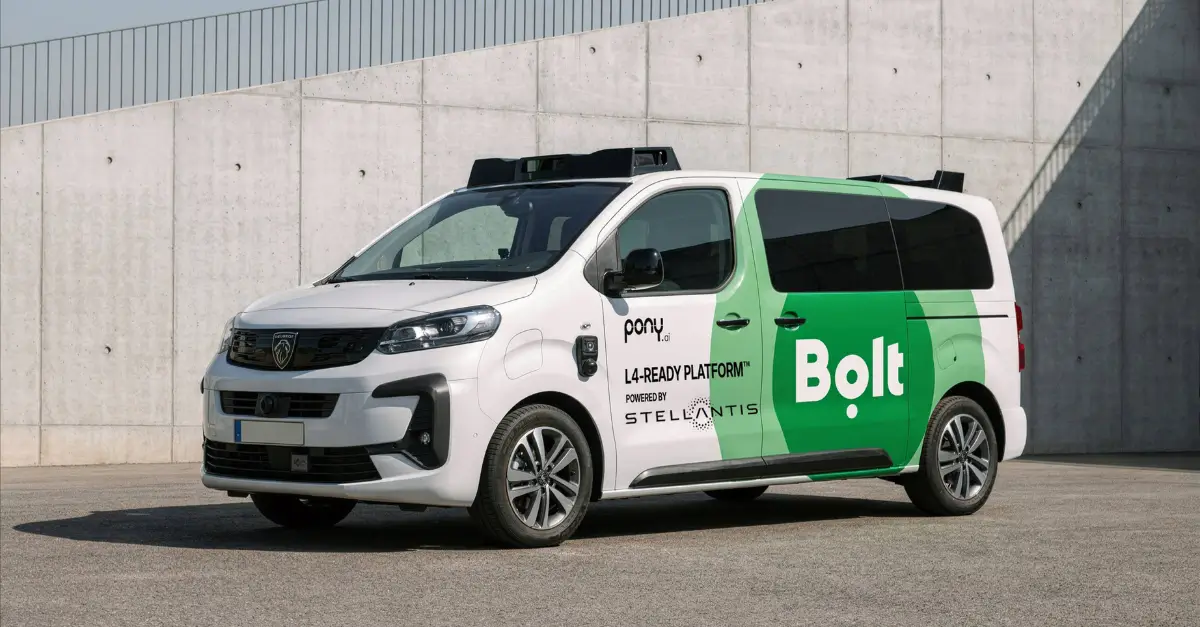
Bolt, Pony.ai and Stellantis test self-driving in Luxembourg
Why did Bolt and its partners choose Luxembourg for its autonomous vehicle pilot? Marc Naether explains the regulatory and ecosystem advantages.
 Lena Mårtensson
14/07/2026
In June 2026, Estonia-based European mobility platform Bolt, autonomous driving technology company Pony.ai and automaker Stellantis announced the launch of an autonomous mobility pilot programme in Luxembourg. The objective: to test the technologies and operational processes required to support safe driverless mobility in cities.
“We will test the whole ecosystem needed: vehicle deployment, platform integration, fleet operations and regulatory coordination,” says Marc Naether, Head of Public Policy BeNeLux at Bolt, who is directly involved in the work of starting up the operations in Luxembourg.
Why Luxembourg is becoming Europe's autonomous mobility testbed
The initiative is part of Bolt’s ambition to accelerate the transition from privately owned cars to shared mobility. At the launch of the project, Markus Villig, founder and CEO of Bolt, pointed out that autonomous mobility technology is transforming transportation around the world, and that Bolt wants to be at the forefront of scaling this technology in Europe. Pony.ai, which chose Luxembourg as the base for its European expansion in 2024, contributes to the project with its autonomous driving technology and operation experience. Stellantis provides its technical platform enabling driverless operations as well as its vehicle engineering and expertise in manufacturing.
Based on the research and pilot testing we will do here, we will develop a product including driverless vehicles that we can scale elsewhere in Europe.
Marc Naether, Bolt
“We decided to use Luxembourg as our ‘living lab’ to develop our autonomous driving plans,” says Mr Naether. “Based on the research and pilot testing we will do here, we will develop a product including driverless vehicles that we can scale elsewhere in Europe.”
A regulatory head start for autonomous vehicle pilots
Bolt has been in contact with Luxembourg authorities for several years concerning various mobility topics, but the connection regarding the autonomous mobility project came at an event in Brussels in autumn 2025. Mr Naether met Anthony Auert from Luxinnovation, Luxembourg’s national innovation agency, who told him about Luxembourg’s ambitions to become the first European country to roll out automated driving nationwide by 2028. A few months later, Bolt and its partners decided to launch their project in the Grand Duchy.
Luxembourg is one of the few countries that have a favourable regulatory regime for this type of autonomous vehicle pilot project.
Marc Naether, Bolt
“Luxembourg is one of the few countries that have a favourable regulatory regime for this type of autonomous vehicle pilot project,” Mr Naether explains. “We will start by operating under the scientific testing regime for autonomous vehicles (a regulatory framework allowing companies to operate autonomous vehicles for research purposes on public roads [Ed.]), and are currently waiting for our permit to be granted. Next year, the Luxembourg government is expected to adopt a new law allowing the commercial deployment of self-driving vehicles including autonomous taxis. This would allow us to take the next step.”
Three reasons Bolt chose Luxembourg for its autonomous driving pilot
When asked why Luxembourg stood out among potential locations, Mr Naether is specific:
- The suitable regulatory framework – including a scientific testing regime that allows pilot operations before full commercial legislation is in place
- A clear political ambition – Luxembourg aims to become the first European country to roll out automated driving nationwide by 2028, a target that signals genuine long-term commitment rather than regulatory experimentation
- The good testing conditions – a varied terrain with urban and rural roads, flat and hilly landscapes and a mild climate, covering the range of driving scenarios that a vehicle must handle reliably before any commercial rollout
He appreciates the smooth interactions with the ministries of Mobility and of the Economy and with Luxinnovation. “They have supported and guided us in the launch of this project.” He also mentions that regulations and political ambitions don’t always align in all jurisdictions. “But in Luxembourg, the government shows real motivation to attract companies that invest in autonomous driving. Luxinnovation is also a very active partner and keeps suggesting new potential partners that we can interact with.”
In Luxembourg, the government shows real motivation to attract companies that invest in autonomous driving.
Marc Naether, Bolt
Mr Naether mentions Luxembourg’s diverse, international population as an advantage. “At a later stage, this will give us access to very different types of potential users. In addition, the fact that Luxembourg is home to several European institutions and frequently hosts international meetings means that we will be able to showcase our work to officials travelling in and out of the country.”
Bolt's next steps for autonomous driving in Luxembourg
Bolt recently incorporated its subsidiary in Luxembourg. The company is now focusing on the regulatory approval process and on solving the last operational issues so that the project can start as soon as possible. To start its activities, it has rented space in the Technoport incubator at Luxembourg’s AutoMobility Campus north of the capital, where Pony.ai is located as well as several other mobility companies.
The joint initiative with Pony.ai and Stellantis is Bolt’s first autonomous mobility project, representing a milestone in its plans to scale driverless services across European cities. By aiming for driverless readiness by the end of the pilot, the partners are using Luxembourg not just as a testing ground, but as the blueprint for the future of European urban transport.
Photo credits: Bolt