AI sovereignty from the very first step
AI sovereignty is about choices: in technology, infrastructure and timing. Luxembourg has been consistently and deliberately ensuring it makes the right ones, ahead of the curve.
 Lena Mårtensson
26/11/2026
When a handful of companies control the digital infrastructure that runs a continent's banks, hospitals and transport networks, "sovereignty" stops being an abstract political concept. It becomes a business continuity question. For Europe, and Luxembourg specifically, building digital autonomy and resilience have become a top priority. The EU is determined to become a global leader in artificial intelligence (AI) and invests in ensuring both technological superiority and sovereignty. But the path to excellence is not a short one.
A strategic decision
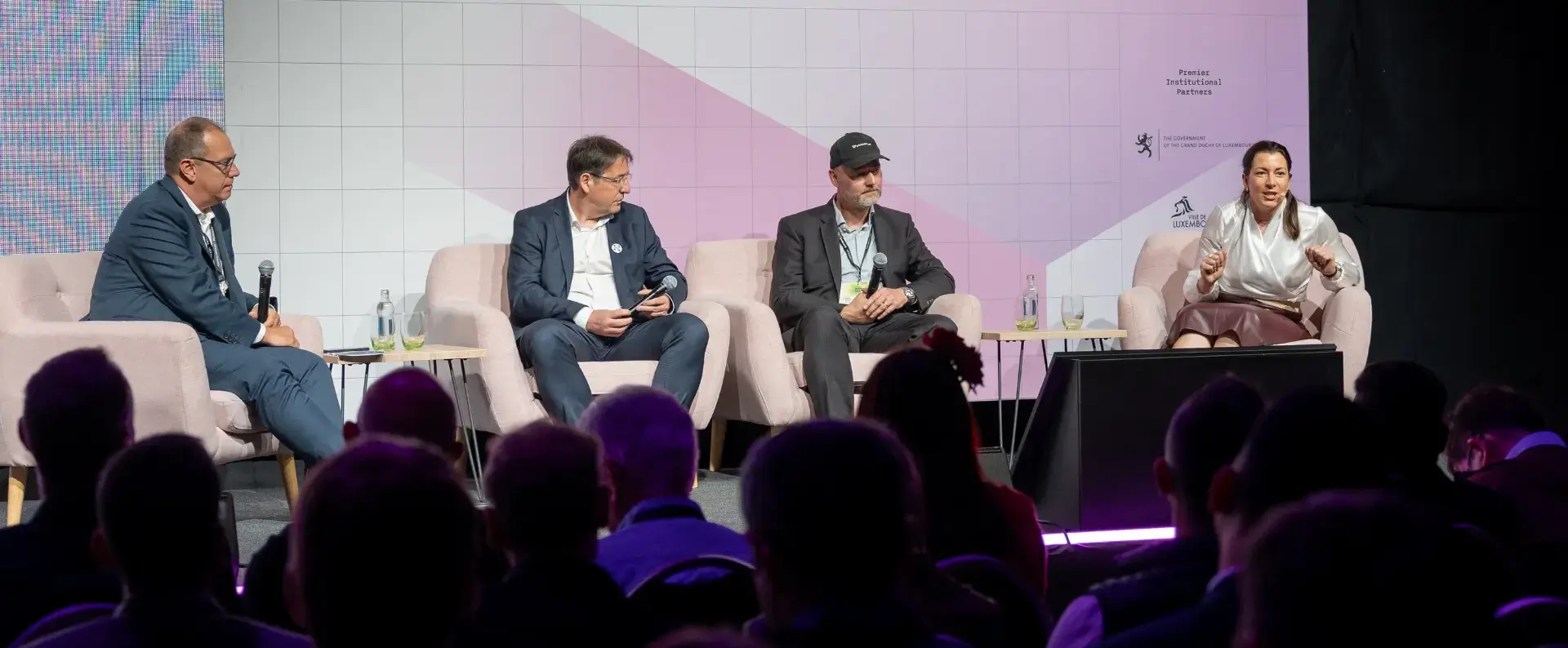
Being sovereign in AI is not only a matter of technology. Eva-Maria Hempe, Executive Director, Public Sector EMEA at AI computing provider NVIDIA, describes it as a five-layer stack: AI applications, AI models, infrastructure, hardware used to run AI workloads and energy production. Each layer implies a sovereignty decision.
“You don’t have to control every single layer – no country in the world does that right now,” she said at tech event Nexus Luxembourg 2026. “Instead, you need to make strategic and informed choices about potential dependencies and decide how you will manage them.”
Her co-panellist, Olivier Debeugny, CEO of the AI company OVHai LLM, pointed out that this does not concern only political leaders; businesses also need to make these choices. “For a business, sovereignty means strategic autonomy. You don’t want to be tied up by one solution only,” he said.
Digital sovereignty – ahead of the curve
Luxembourg is not trying to win at every layer of sovereignty. Instead, it has made deliberate bets and built the infrastructure to back them up. The country published one of Europe’s first national data strategies in 2019, at a time when most governments were still debating whether the data economy was real. In 2025, that strategy was followed by the initiative “Accelerating digital sovereignty 2030”, which focused on data, AI and quantum.
This forward-oriented thinking reflects the country’s economic story of deliberate reinvention. From steelmaking as its main economic activity, it pivoted to financial services in the 1980s. It then invested in the digital economy, followed by data, AI and supercomputing. Each transition was the result of political decisions made ahead of the curve. The economic case often came later.
“The key question was never ‘what is trending right now?’ but ‘what will matter in ten years, and how do we position the country now?’,” said the third panellist, Mario Grotz, CEO of Luxembourg’s national innovation agency Luxinnovation. “Investing in digital sovereignty now is essential for enabling AI innovation in the coming years.” For companies evaluating where to develop their digital innovations, that track record of following through matters as much as any policy document.
Building a digital ecosystem for all
To fulfil its ambitions, Luxembourg has invested in sovereign infrastructure, including ultra-secure and highly resilient Tier IV data centres, sovereign cloud solutions, supercomputing, data governance and an ecosystem that facilitates AI adoption and development. It serves all the actors using and innovating in AI: businesses, academia and public bodies. “A model that only works for large research institutions or corporates leaves most of the economy behind,” said Mr Grotz. “A model that works for everyone – from a ten-person fintech startup to a ministry – scales differently.”
Luxembourg’s national supercomputer, MeluXina, is a good example of this. When it was launched in 2021, most European supercomputers were primarily designed for research simulations. MeluXina was designed for business use from day one. Its architecture enables simulation, modelling, data analytics and AI workloads on a single system. It was AI-ready before AI became the dominant supercomputer workload – and this didn’t happen by coincidence.
In addition, MeluXina’s hybrid architecture supports workloads of different sizes. This makes it accessible to companies that don’t need full capacity for their projects.
AI Factories: the bridge to impact
But making infrastructure available doesn’t automatically translate into use. Particularly smaller companies find it difficult to navigate the complex landscape of digital infrastructure. “The demand is real,” said Mr Grotz. “But for some businesses, the ramp-on is the bottleneck.”
To bridge this gap, the EU has set up a network of 19 AI Factories that give access to computing power, data and talent. Luxembourg’s own AI Factory targets companies at all stages of their AI journey, whether they are just starting or seeking the power and expertise to scale their growth.
Replacing “think big” with “think smart”
NVIDIA’s CEO Jensen Huang described the global AI boom as the “largest infrastructure buildout in human history”. Most of the world’s AI computing power is in the US, while Europe is investing heavily to catch up. Luxembourg will never compete on raw scale. But scale has never been the point.
Small countries that think clearly and invest consistently can lead in the computing continuum – not despite their size, but because of it.”
Mario Grotz, CEO Luxinnovation
“Small countries that think clearly and invest consistently can lead in the computing continuum – not despite their size, but because of it,” explained Mr Grotz. “If you have access to the best data, the right infrastructure and the domain expertise that matches your use case, you don’t need to have the biggest model.”
OVHai LLM is the perfect example of this approach. In 2025, it rolled out a new, highly efficient LLM (large language model) architecture. Instead of consulting all available data when responding to a prompt, it consults only specific memory blocks. This allows it to provide faster responses using smaller machines that consume less energy. The algorithm was trained on the European network of supercomputers, of which MeluXina is a part. “We have proven that, with a team of 15, computing power made available by the European Commission and European data, it is possible to create ‘made in the EU’ successful foundational models,” Mr Debeugny said.
Mr Grotz extends an invitation to companies worldwide looking to innovate in the AI space for the European market. “Luxembourg is not large enough to pretend that what it builds will be enough to serve Europe. But it is positioned – by size, openness and the concentration of its ecosystem – to be a testbed, a reference model and a proof of concept for inclusive sovereignty at national scale.”
The infrastructure is built. The framework is in place. The question now is who decides to use it.