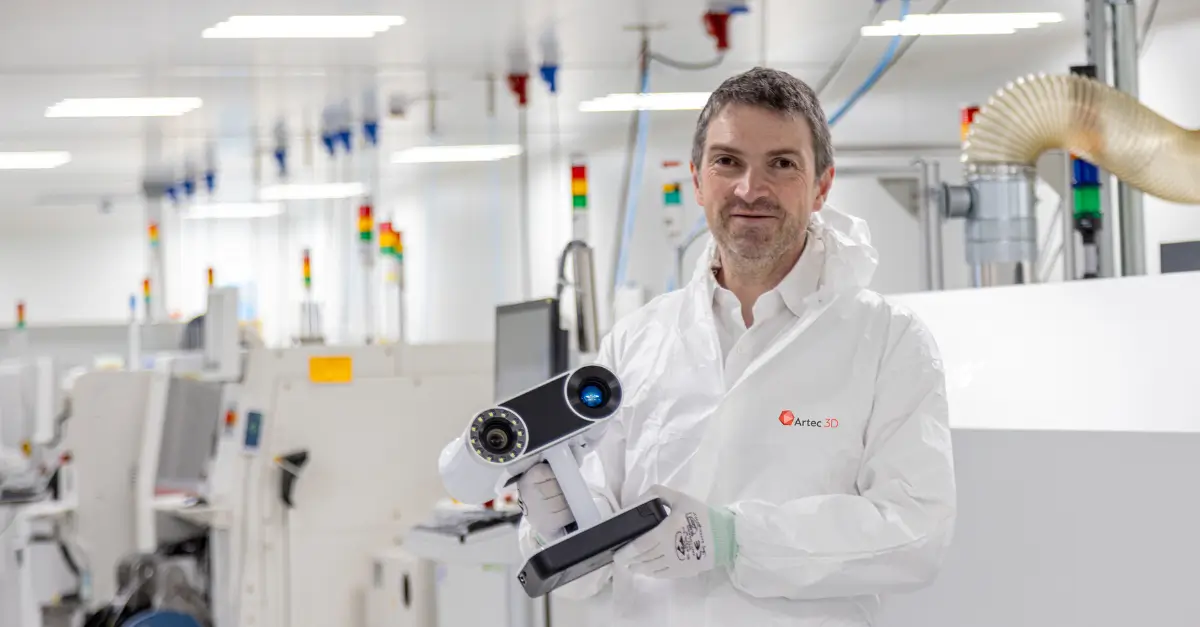
Pioneering 3D scanning and digital twin technology from Luxembourg
3D scanning leader Artec 3D moved its headquarters from Silicon Valley to Luxembourg. From here, its digital twin technology services Fortune 500 companies and researchers worldwide.
 Lena Mårtensson
17/09/2026
Artificial intelligence may dominate today’s headlines, but for Artem Yukhin, CEO of 3D scanning technology leader Artec 3D, it is nothing new – he was lecturing on AI and machine learning for computer vision already in the late 1990s. In 2008, together with his co-founders, he set up Artec 3D in Silicon Valley to pioneer the development of compact, handheld 3D scanners capable of capturing data without fixed targets and creating highly precise digital models. “We are still the market leader in this field,” he confirms.
A year later, the young startup had already reached break-even after signing major Hollywood studios as clients, which used its scanners to integrate special effects into film scenes. Toyota, a world leader in quality control, was another early client.
Today, after almost two decades, Artec’s 3D scanners are used in fields ranging from manufacturing and civil engineering to law enforcement and cultural heritage. The company’s clientele includes top-tier Fortune 500 companies, leading museums and 800 universities, and its software was used to create Apple’s Face ID. Mr Yukhin is particularly proud of how the scanners are used in healthcare, for instance, to scan patients who have lost limbs to produce perfectly fitted prostheses, and the growing number of scientific articles featuring breakthrough research results enabled by Artec 3D scanners.
A regional office turned global HQ
As most of its early clients were European, Artec 3D quickly saw the need to open a European sales office. “Finding the right European location to serve markets with different cultures and languages is a big challenge for an American company,” Mr Yukhin points out. The choice fell on Luxembourg. “This country is unique: both French-speaking and German-speaking countries see it as a sister country, and it has excellent relations with key global markets, including Japan and China. Strategically, it is a very good location.”
Finding the right European location to serve markets with different cultures and languages is a big challenge for an American company.
Artem Yukhin, Artec 3D
The EU office in Luxembourg opened in 2010, and a year later, the management decided to move the global HQ to Luxembourg. The decision proved easy. “We just fell in love with this country,” says Mr Yukhin. Today, over 120 of the company’s 200 staff members are based in the Grand Duchy, which also hosts its R&D centre and top-range production line. “Our employees from over 20 different countries feel at home here. Luxembourg’s multilingual, multicultural and friendly environment helps us attract top talent.”
Spearheading large-scale digital twin technology
The 3D scanners made in Luxembourg create highly accurate 3D models of objects with various textures, sizes and geometries. However, Artec 3D’s unique value lies in its algorithms for multi-source data fusion.
“There are many scanners in the market today that are either handheld or static, but each has its limits and different workflows. We can combine data from different scanners and create very large digital twins through a single workflow, without any trade-offs in terms of quality or accuracy,” says Mr Yukhin.
We count on the Luxembourg AI Factory's AI-optimised supercomputer to power our next-generation AI-driven 3D scanning capabilities.
Artem Yukhin, Artec 3D
Over the years, he has seen clients’ focus change from scanning smaller objects to creating large-scale digital twins of, for example, civil engineering projects or smart factories. By combining terrestrial and handheld scanners with the company’s newest product – a long-range, autonomous scanner capable of capturing shots from 300 metres – the team has scanned an entire building and its surroundings in less than an hour. The resulting digital twin includes details of the façade with a precision of 0.1 mm.
Producing such state-of-the-art solutions requires constant investment in R&D. Artec 3D has obtained several R&D subsidies from the Luxembourg government, enabling it to hire additional international talent. Last year, the company also signed a partnership with the European Investment Bank, which will support its R&D and innovation in next-generation scanning technologies with €15 million over the next three years.
Future focus on space, defence, security
The digital twin market is growing by 30-35% year-over-year, Mr Yukhin notes, and he is positive about the future. He expects the company to expand its current verticals and move into new fields such as defence and public safety.
Moving here from Silicon Valley was clearly our best decision.
Artem Yukhin, Artec 3D
However, processing the amount of data generated from major projects in these fields would require high-performance computing capabilities. “We count on the Luxembourg AI Factory's AI-optimised supercomputer to power our next-generation AI-driven 3D scanning capabilities.”
Mr Yukhin also highlights the strong support for international expansion provided by the Luxembourg government and the Chamber of Commerce. “Moving here from Silicon Valley was clearly our best decision.”
Photo credits: Luxinnovation/René Garcia
This article was originally published in Crossroads Magazine no. 9. Read the full edition below: